

The best way to motivate employees to track time is to have open conversations about the positives of time tracking and allow them to express their concerns. Tracking one’s time can sound invasive, but the reality is that it is beneficial to all personnel.
Why Track Time?
Time tracking isn’t necessarily a new thing, but the way it can be done is. Time tracking software allows for more accurate tracking and ease of use.
Tracking is the best way for employees and management to see how time is being used and where adjustments can be made. Well-managed time not only affects work, but also the lives of every employee. Accurate time tracking means fewer payroll mistakes and that is a positive for employees.
Do Employees Dislike Time Tracking?
Employees may view time tracking as a negative if they’ve never been exposed to it. “Tracking” sounds like they are being watched and their every move will be known. It’s understandable how those thoughts can lead to negative connotations.
After regular use, employees find this type of system to be efficient, accurate, and helpful. It will only be disliked if it hasn’t been explained well or has never been used.
When Timesheets Fail
Eventually, timesheets will fail personnel. Whenever manual entry of anything is expected, human error is bound to happen.
For example, a job is completed, and an employee realizes they forgot to record when they started. As another example, an employee has yet to clock in after already being at work for a few hours. Both are easy mistakes and can happen to anyone. Often, these are employees who are efficient at their job and take hard work seriously, which makes it easier to get side-tracked by the tasks at hand and forget manual time tracking.
Time Tracking Software for Accuracy
As mentioned before, time tracking using the right system creates better accuracy for everyone. Hours clocked in and out are exact, so employees are paid fairly. Projects can be tracked for time, so again, employees can show how hard they work and how long each task truly takes. This type of tracking is also helpful for clients and customers asking how long a project will take. Using time-tracking data, employee work hours can be better estimated.
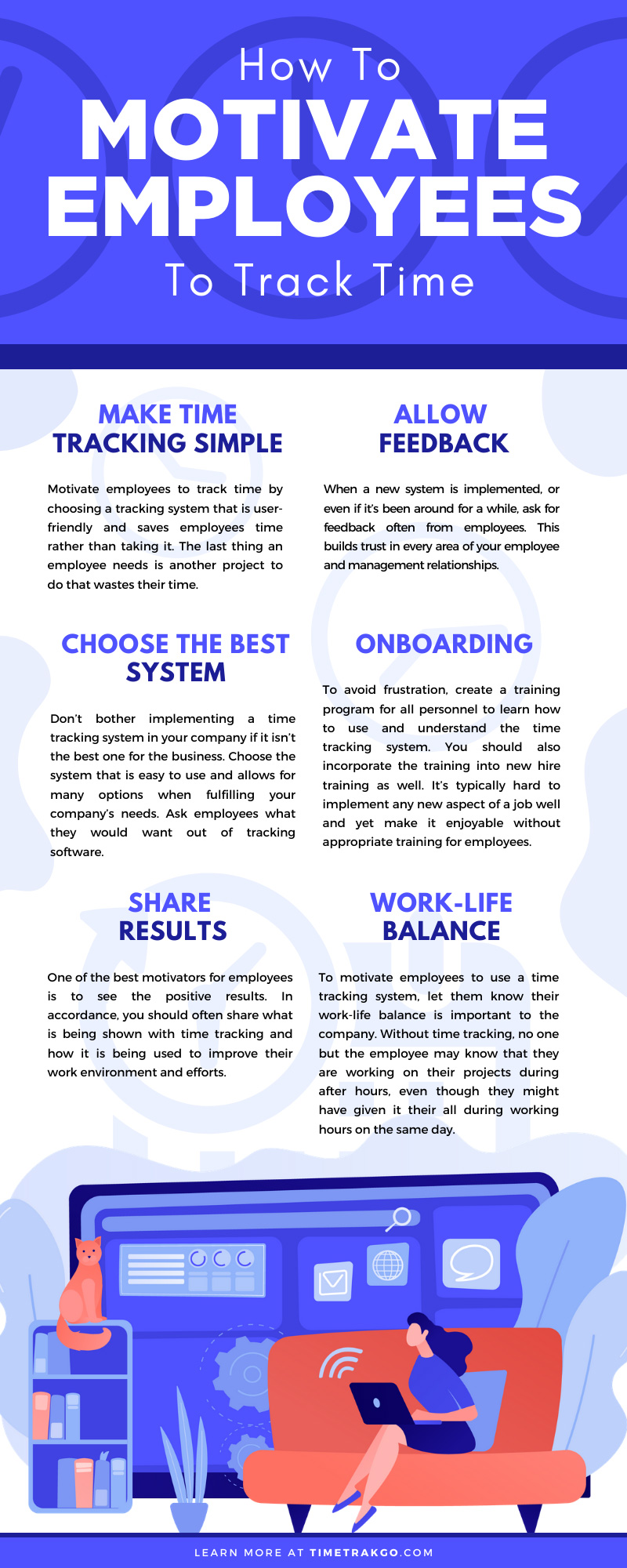
Make Time Tracking Simple
Motivate employees to track time by choosing a tracking system that is user-friendly and saves employees time rather than taking it. The last thing an employee needs is another project to do that wastes their time. Also, use the options on the software that are helpful and not simply busywork. Get employees’ input as to what those would be.
Allow Feedback
When a new system is implemented, or even if it’s been around for a while, ask for feedback often from employees. This builds trust in every area of your employee and management relationships.
You can surely expect there to be some negative feedback. Try to be prepared by understanding the time tracking system very well yourself. Employees will appreciate you nodding your head in agreement and wanting to fix those glitches too.
Make feedback a two-way street. Don’t just ask for anonymous surveys and leave it at that. Give your input also, and make the feedback a discussion for everyone. Let your employees know you are on the same page, and that together, you will all learn how to incorporate the positives from time tracking.
Choose the Best System
Don’t bother implementing a time tracking system in your company if it isn’t the best one for the business. Choose the system that is easy to use and allows for many options when fulfilling your company’s needs. Ask employees what they would want out of tracking software. Time tracking won’t be useful to anyone if you don’t choose the best system.
Onboarding
To avoid frustration, create a training program for all personnel to learn how to use and understand the time tracking system. You should also incorporate the training into new hire training as well. It’s typically hard to implement any new aspect of a job well and yet make it enjoyable without appropriate training for employees.
Share Results
One of the best motivators for employees is to see the positive results. In accordance, you should often share what is being shown with time tracking and how it is being used to improve their work environment and efforts.
As a manager, don’t shy away from admitting you were unaware of how long some tasks actually take. Use information like that to point out the importance of time tracking for all employees. And, be sure to thank your employees and let them know that adjustments will be made thanks to time tracking. In the same way, recognize employees’ efforts when it is clear that they are using their time very wisely through time tracking.
Work-Life Balance
Balance is a sought-after word for many, and for a good reason. No matter where our place on the corporate ladder is, we need balance in our lives. To motivate employees to use a time tracking system, let them know their work-life balance is important to the company. Without time tracking, no one but the employee may know that they are working on their projects during after hours, even though they might have given it their all during working hours on the same day.
Thanks to tracking, management can see that the maximum effort that employees put in and that a certain project may require a longer timeline. Time tracking is for their benefit and recognition as well, and not just for the simple sake of allowing management to see everything—and employees need to know that.
Overall, motivating employees to track their working time isn’t difficult when done out of respect and a desire to improve employees’ lives. When implementing an employee time tracking system, make sure to explain the benefits and train employees properly so everyone gets the most out of it. In addition, make it a point to share positive results so everyone can see that time tracking is something they have been missing out on, and will want to continue to use.
TimeTrakGO provides simple employee clock software for your company’s time tracking needs. We are happy to answer all of your time-tracking questions and find what will work best for you and your personnel.